Saturday, 23 January 2021

Message to clients

I retired from my day-job as a test systems design engineer in April 2020 with the view to spending more time on my part-time business/hobby Synovatron. However due to a number of factors (mainly age, health, fitness and to a lesser extent COVID-19 restrictions and Brexit) I have reluctantly decided to call it a day on Synovatron and retire completely

From 1st February 2021 Synovatron Limited will cease to trade and will not be taking any new orders from then. I will, however, retain spares and test equipment in order to provide support and warranty cover for any Synovatron products sold directly by me or by retailers during 2020, 2021.  

The Synovatron logo is a representation of me and my wife (the two birds) flying off into the sunset so I guess I always realised this point would come, I wish that I had the fitness for it to have been further away, but that's life. So long and thanks for the interest, I really enjoyed making stuff that people use for creative sound exploration. I will be refurbishing my house, spending precious time with my family and actually playing my own synths (for once). Keep safe you lovely people.

NOTE: Some products (e.g. CVGT1, Euro Bananas, Jacks) may find their way to various retailers and some may even be continued by other parties (and possibly rebranded) yet to be confirmed. Watch this space - I will post any news if anyone does take up continued production.


Tuesday, 28 April 2020

Moog Voyager XV-351 Output Adaptor

If you have a Moog Voyager (the backlit version, not the Old School or RME versions) and you want to connect a VX-351 Output Expander you need to have an Output Adaptor fitted to the output ribbon cable connection on the Voyager's analogue board. The trouble is that Moog no longer provide these and if you have bought a VX-351 for your Voyager and the VX-351 seems to be misbehaving (CV instability or noise) then the chances are you don't have an adaptor fitted.

A few years ago I set out to design a eurorack module that did much of what the VX-351 does i.e. output all the Voyager's internal signals (CVs and gates) but to make them a little more eurorack friendly and add a few twists: red and white noise, random gate pulses, more LFO wave shapes and variable slew. The result was the VXP1 (you can read all about the VXP1 here). 

I also could not get VX-351 Output Adaptors to sell as part of the VXP1 package so I designed my own version from scratch to be a 'form-fit-function' replacement. I use it with both my VXP1 and VX-351 and it works a treat!

VXP1 Output Adaptor

To be clear you do not need this if you want to use a VX-351 (or VXP1 for that matter) with Old School or RME Voyagers.

Check out this useful 3rd party web page which describes how to open the Voyager and fit the Output Adaptor .


Friday, 3 August 2018

Modules and Kits from Synovatron

Updated 31st January 2021: Synovatron will cease to trade from 1st February 2021 onwards. The following products will no longer be available from Synovatron Limited. Some items will be available from retailers and I will post the status of those when I know the final state:

CVGT1 - 8HP Euro to Buchla CV-gate-trigger-pulse translator
No longer available directly - please check out Noisebug or SchneidersLaden who have may stock of modules.

VXP1 - 14HP Voyager Output Expander
No longer available

VXP1-OS - 14HP Old School Voyager Output Expander
No longer available

Jacks - 4HP 3.5mm minijack to 1/4" jack format jumber
No longer available directly - this may become available for sale by another company - watch this space, I will update when I know

Euro Bananas - 6HP 3.5mm minijack to 4mm banana socket format jumbler
No longer available directly - this may become available for sale by another company - watch this space, I will update when I know

Trunks & Mults - 6HP 8-channel trunk lines and two 4-way multiples
No longer available directly - this may become available for sale by another company - watch this space, I will update when I know

More info on Jacks, Euro Bananas and Trunks & Mults modules and kits on this page.  


Euro Bananas, a pair of Trunks & Mults, Jacks, CVGT1 and VXP1


Limited edition Black Gold CVGT1 (SOLD)

Sunday, 10 April 2016

VXP1 Voyager Output Expander for Eurorack

(BLOG UPDATED 3rd August 2018)

News


VXP1 and VXP1-OS are no longer available from Synovatron for £180.00 GBP. 

Preliminary user manuals can be downloaded from these links:
VXP1 Handbook Rev 1.0 
VXP1-OS Hand Book Rev1.3

Back Story

A few years ago I designed and built a Eurorack interface for my Moog Voyager. I built it in a week to take to the Brighton Modular meet to see if there was any interest in such a module.

I have a Moog VX-351 which is a perfectly lovely bit of kit but I wanted something that had 3.5mm minijacks to make it easier to use with my Eurorack and Roland 100m modulars. The module I built was a simple breakout panel that had one jack per signal available on the Voyager's Accessory Port (a 25 pin D connector). Most signals were wired straight through but one or two included active electronics to provide scaling to give a more useful 5V range, in particular Keyboard Pitch had a scaling amplifier and a trimmer to set it exactly to 1V/octave. LEDs with driver circuits were also added to the LFO and the two gate signals.


Prototype Voyager Output Expander

Most modular users don't have a Voyager (and sadly it's now out of production) so I didn't get too much interest at the Brighton meet but I did get some interest on Twitter and Muffwiggler and in particular from one wiggler whose frequent enquiries about its development has spurred me on to develop it. It has been very slow going due to a number of reasons (not all connected to the module itself, the real world has a way of changing one's focus!).

Output Adaptor Retrofit

One reason for procrastination was due to an error in Moog's design of the Voyager's Accessory Port which was not suitably buffered; which means that when a cable is connected to the port some of the signals become unstable and oscillate. Moog's remedy for this was to use a small adaptor board that has to be retrofitted inside the Voyager between the main circuit board and the Accessory Port's ribbon cable (this just affects backlit types, not the Old School version).

The Output Adaptor is a small circuit board that adds a 330 Ohm resistor in series with many of the signals; here is a link to an installation guide. The 330 Ohm resistance is enough to isolate the capacitance of the extra cable length which maintains amplifier stability (ED Note: If you want to understand about amplifier stability then this series of 5 short videos by Analogue Devices is the perfect intro, in particular video 4 which describes this problem nicely. Ideal for anyone designing with op-amps).

As you will see from the installation guide that fitting the adaptor is a bit much for some people to take on and I didn't want to encourage inexperienced Voyager owners to open up their expensive synth and potentially damage it or harm themselves (there is an AC mains hazard around the power inlet if you don't disconnect from the mains). Unfortunately there is no other solution other than to use an Output Adaptor (like that supplied with the VX-351) so fit it if you are confident or get a music shop tech to fit it for you. You might already have one fitted if your Voyager has been used with the Moog VX-351. I tried to find a source of Moog Output Adaptors but alas no joy so I designed one from scratch; problem solved! Here it is:


Smaller, Better

Another reason for delay is that I increased the scope of what the VXP1 can do; I didn't want this to be a Eurorack rip-off of the VX-351. Rather than just a simple breakout panel it now handles each signal with active electronics as follows:
  • All signals are filtered, buffered and have the necessary gain and drive to give more Eurorack-friendly output levels.
  • The smooth and step Sample and Hold outputs are replaced by just one output and a variable control to give an adjustable slew to Sample and Hold.
  • There are more LFO waveforms: ramp, saw and 10V clock.
  • There are more noise options: white, red and random pulses.
  • The panel is narrower than the first prototype: 16HP down to 14HP.
Here is the second prototype panel I have used during my development (a simple but mechanically accurate panel with engraved text made by Schaeffer):


Here is the panel design:


For Old School Voyagers which don't have a touch panel the VXP1-OS has repurposed the redundant TOUCH sockets to become a 3-input gate combiner. 


VXP1 Module, Cable and Adaptor | VXP1-OS Front Panel


Saturday, 13 June 2015

New Euro to Buchla CV Translator - CV1.2

The CV1.2, one of the cvgtElements range of DIY circuits, is available and its data pack is ready to view/download on the support page. CV1.2 is ready built and tested, you have to DIY them into your own modules/panels.

CV1.2 takes a Euro 1V/octave CV and translates it into a Buchla 1.2V/octave CV - ideal if you want to take a Euro pitch CV into the Music Easel's pitch KEYBOARD CONNECTION


The GTPulse datapack is also available to view/download on the support page.

Friday, 22 May 2015

Synovatron Documents Downloads

EDIT 31May 2015:

For those who have tried to download from links printed on kits, fliers and data sheets etc without success: I apologise but the original file hosting site has shut down without warning in recent weeks. All Synovatron docs have now been rehosted onto Google Docs where they can be viewed or downloaded. The new links are shown on the Support tab above where all downloadable documents will be maintained from now on - if you experience any problems with file downloads please email me at synovatron@btinternet.com. Keep an eye out for new and updated documents. Any additions or significant updates will be announced on the blog as they occur.

The documents added to Google Docs are:-

CV Tools User Manual 
CVGT1 User Manual 
cvgtMM User Manual 
GTPulse Data Pack 
ASM2DB Adaptor Fitting Instructions & uZeus Tech Note 
DM2ASB Adaptor Fitting Instructions 
5ASM2DB Adaptor/Expander Bare Board Data Sheet and Fitting Instructions

Saturday, 17 January 2015

ASM2DB Tech Note for use with uZeus ribbon cable bus

Here is a guide if you are using the uZeus ribbon cable backplane.

(apologies I didn't have a real uZeus backplane to hand but hopefully you get the idea)

Saturday, 8 November 2014

Custom Half-width Buchla Modules

I was asked to design and build a pair of custom half-width Buchla modules for some clients. They each had two half-width slots spare in their custom built cases and wanted to fill the spaces with Euro to Buchla CV and gate translator modules.


The brief was simple (and the same for both clients): 5 channels of 1V/oct to 1.2V/oct CV translation and 5 channels of gate boosting to Buchla levels; the Buchla stepped pulse was not required, just big pulses (10V or more).

This was a great opportunity to use the Synovatron Proto range of prototyping boards which accomodate 5 channels and offer stackability if more circuitry is required than will fit on one board; see below.

The Proto range of boards
As the Proto boards are designed primarily for Euro there was space on the 4U Buchla front panels to add some extras in the form of a passive attenuator. Here are the front panel designs that we agreed on:-

CV and Gate modules
To keep costs down it was decided not to have panel marking as the functions are obvious.

The CV module design used a straightforward precision amplifier with gain of 1.2000 (yes that accurate), 1M Ohm input and 0 Ohm output impedances. The gate module used comparators and output and LED drivers. The outputs each have diodes in series allowing them to be wire-ORed by just connecting outputs together (common to Buchla, wish it was used on Euro).

The CV module electronics fitted nicely on a ProtoJax board with plenty of space as you can see:-


For the gate module I decided to put the input comparators and sockets on the ProtoJax board and output buffers and LEDs on the ProtoXp board and stack them together (it  probably could all have been put on one board but it was simpler to make use of the space). The stacked ProtoJax and ProtoXp boards can be seen here:-


The gate board was powered from an MTA connector and the CV board took its power from the gate module (hence the 10-pin ribbon headers for a linking ribbon cable); this was at the client's request as they only had one spare connector (these are very low current modules and daisy chaining them didn't cause any crosstalk issues). 

The finished panels looked pretty good; they were made by Schaeffer using Front Panel Designer http://www.schaeffer-ag.de/en/front_panel_designer/the_idea/.

  
If you are interested in the Proto range of PCBs or in having a custom module built then please contact me at synovatron@btinternet.com


Saturday, 27 September 2014

Synth Repairs


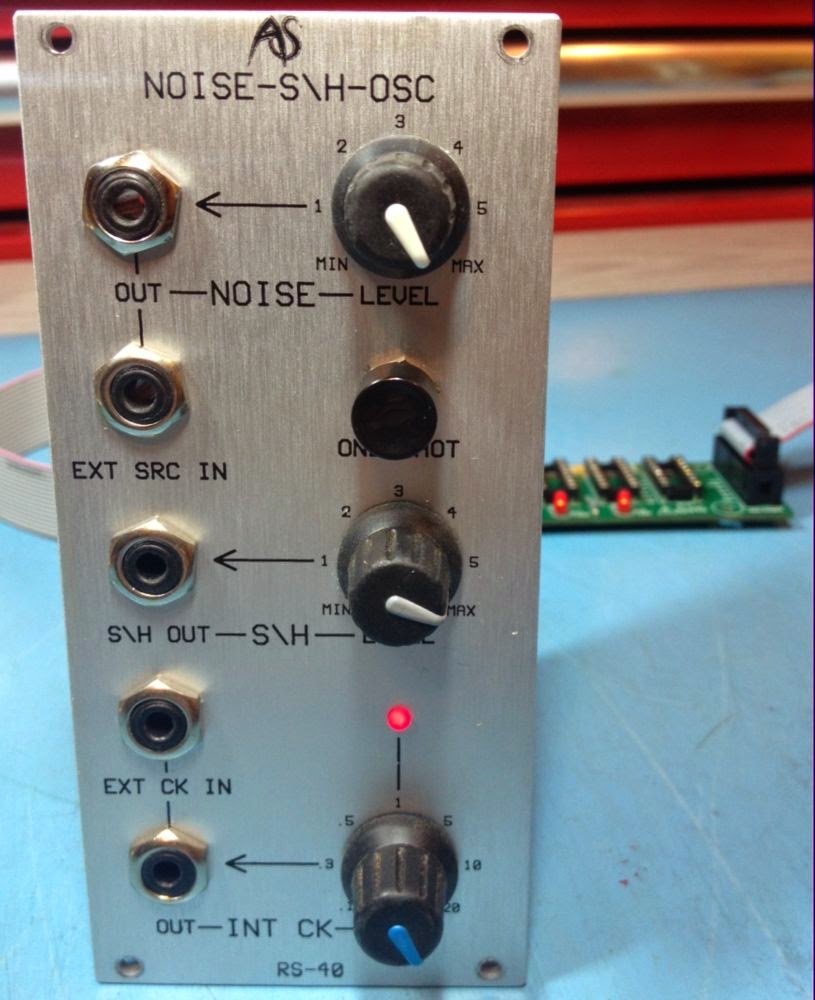
Analogue Systems RS-40 Noise, Sample and Hold, Osc


This came in as 'defective'. After a while it became obvious the noise output was not working. This was traced to an open-circuit LEVEL contol pot (10k lin) which was replaced. Still it didn't work as a sample and hold - i.e. I was expecting to see a stepped output from S\H OUT. Not having used the RS-40 before it took me a while to realise that the noise and clock signals are not normalled to the Sample and Hold circuit like the front panel markings suggest; the lines linking NOISE OUT to EXT SRC IN and INT CK OUT to EXT CK IN suggest to me these are linked in some way but no. 
RS-40
After looking at the jacks it was clear that these are not normalled (I'm not sure if this is the case with all RS-40s but this one looked clean and unmodified so I'm assuming it was factory standard). I used external patch leads and to link the noise and clock outs and ins and hey presto it worked. The first thing that I saw on the scope was at each sample point the sampled signal is present for what I guess is the duration of the sample pulse (about 0.2ms). When using the RS-40 to modulate a VCO I could not tell that the noise spikes were a problem, in fact it is probably above hearing range (at least mine). 
 
Noise spikes

However I didn't much like it and I didn't much like not having the noise and clock not normalled to the S/H circuit. I spoke to the owner and he agreed to have a couple of simple mods applied.

The noise and clock signals are present on the jack board close to where they would have to go for normalled connections. The switched contacts were connected to ground on both EXT SRC IN and EXT CK IN jacks by solder bridges. I removed the solder bridges and fitted links as can be seen here. This worked a treat allowing it to work without patching but still allowing external signals to be patched in if need be.

Solder removed from red arrows and links applied at yellow arrows
The noise spikes 'problem' although not audible was fixed by placing a 10nF cap across the S/H output amplifier's feedback resistor (27k) making it a low-pass filter with a cutoff of 590Hz. This got rid of the spikes without adding noticeable slew.

10nF capacitor

Spike free steps


Saturday, 13 September 2014

5 into 1 Analogue Systems to Doepfer Bus Adaptor/Expander

The new 5ASM2DB Analogue Systems Module to Doepfer A-100 Bus Adaptor/Expander is now in stock and available to order. 

SchneidersLaden have stock of 5ASM2DB which can be ordered from their website at http://www.schneidersladen.de/en/manufacturer/synovatron.html.

For DIY enthusiasts it is also available as a kit or as a bare PCB direct from Synovatron (please email synovatron@btinternet.com). 

The 5ASM2DB offers five Analogue Systems sockets on one small circuit board with low-current LED indicators to show that ±12V and +5V power is available. It comes with a ribbon cable to connect to the A-100 bus and four self-adhesive nylon PCB mounting pillars (you can of course use screwed in pillars so a drilling template will be provided).

If you have several Analogue Systems modules in a Euro rack then the 5ASM2DB could be a better alternative to using several ASM2DB Adaptors because it expands the bus and frees up A-100 Bus connectors for Euro modules; it costs roughly the same as three ASM2DB Adaptors. ASM2DB and DM2ASB Adaptors are still available.

5ASM2DB Adaptor/Expander
5ASM2DB DIY Kit

Friday, 29 August 2014

New product preview

This is a design that has been hanging around for over a year in a 95% complete state but I have now taken the bold step of finishing it and going into production. It is called the 5ASM2DB and is a 5 socket version of the popular ASM2DB Analogue Systems module to Doepfer bus Adaptor. It is fabricated on a small circuit board and has 3 LEDs that indicate the presence of ±12V and +5V. The 5ASM2DB will be supplied with 4 self-adhesive nylon mounting pillars and a short ribbon cable so it can be placed adjacent to a busboard and linked via the ribbon cable (standard Euro rack 16 pin cable). It is not recommended for use with the Analogue Systems RS-370 as this draws a whoppng 680mA from the 5V rail.

It will be priced at roughly that of 3 ASM2DB Adaptors so the aim is you get 5 for the price of 3; which will be of interest to those of you with many Analogue Systems modules to go in a Eurorack case.

Availability is from mid-September and will also be available as a DIY kit and as a bare PCB for the more adventurous DIYers. Here's an image from the CAD package - it will not be red BTW!


Confused by Cwejman ribbon cables?

I received an order to build some Cwejman standard ribbon cables that were 40cm long. Up until then I had no idea they were different to standard Eurorack cables. So here is what I found out and hopefully this takes the mystery out of it for anyone who is lucky enough to own one of these top modules (and it's also a sales plug - no pun intended).


Saturday, 12 July 2014

Eurorack DIY Prototyping Cards Rethink

Post updated 3rd July 2018

The Synovatron Eurorack DIY Kits have now been discontinued. Because many of the kit components are easily available from online retailers it made sense that Synovatron just provides the unique (e.g. PCBs) and harder to source parts (e.g. pot brackets). This provided a great opportunity to reassess the PCB designs rather than just reorder more of the same.

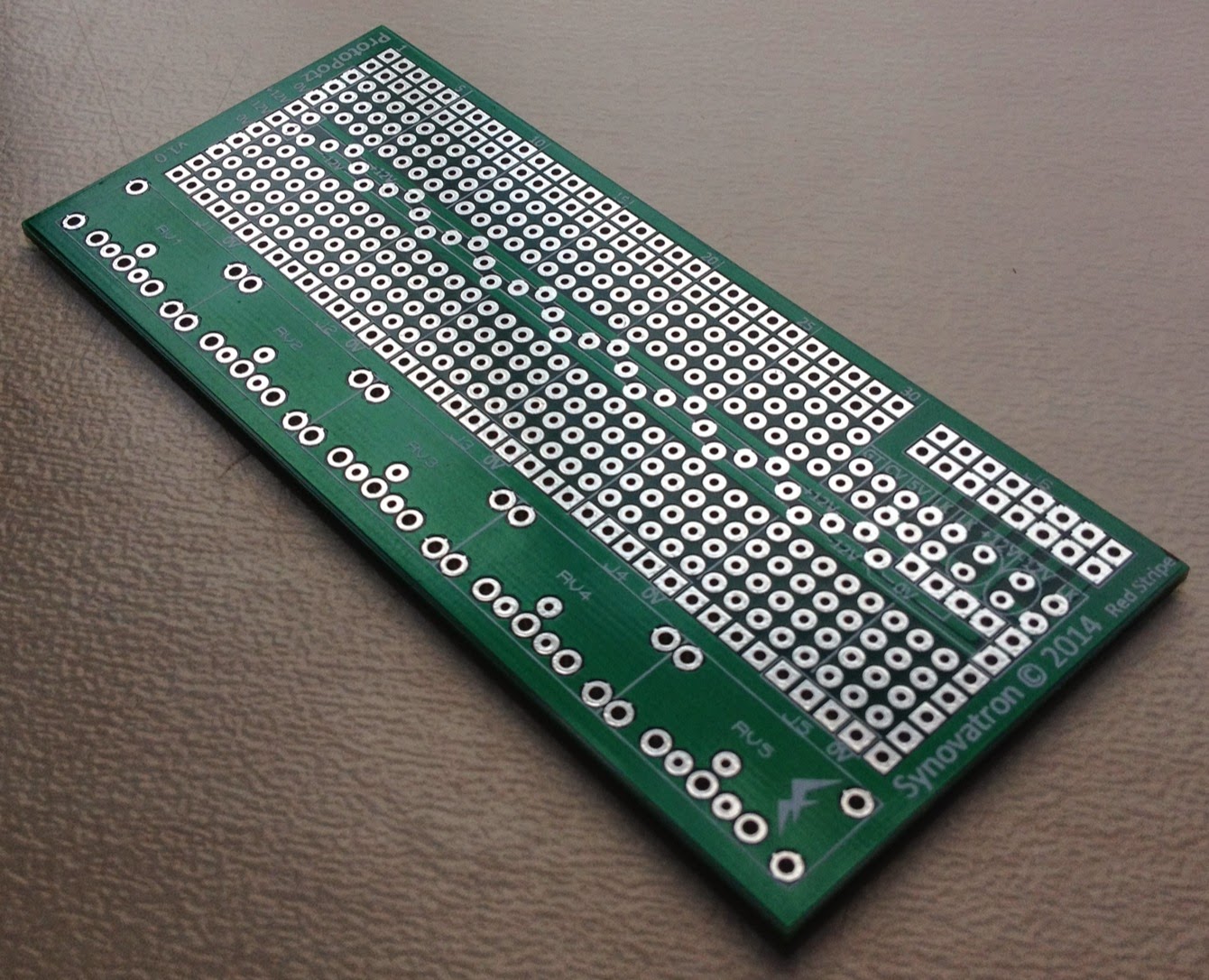
What has emerged is a revised and rebranded Eurorack prototyping solution that is more usable and more elegant than before. The revised product revolves around three PCBs in the Synovatron Proto series: ProtoPotz, ProtoJax and ProtoXp

The new Proto PCBs' holes line up with each other to allow each board to be stacked one on the other using header plugs and sockets; allowing power and signals to be routed between boards without resorting to linking ribbon cables. Here is an example board stack-up:

ProtoJax, ProtoPotz and ProtoXp boards stacked together


Examples of headers and sockets used to stack the boards

ProtoPotz

ProtoPotz is the direct replacement for DIY1 PCB (as used in DIY Kit 1 and DIY Kit 2). It is designed to hold up to five 16mm P160KN series pots using brackets. What's new about it?
  • Plated-through holes for robustness and convenience, essentially it's a double-sided PCB. 
  • Better supports the A-100 bus with dedicated positions for 10 or 16-way open or boxed headers, small electrolytic capacitors and protection diodes (to protect against reverse power connection.


ProtoPotz pot breadboard PCB
Here is the range of pots available from Mouser that Synovatron recommends for use with ProtoPotz:-

ProtoJax

ProtoJax is an evolution of DIY2 and DIY3 PCBs. It is designed to hold up to five Cliff CL1384 3.5mm mono jacks. It is almost identical to ProtoPotz except it has footprints for jacks instead of pots and another two rows of breadboard holes. What makes it more advanced than DIY2 and DIY3 pcbs?
  • Larger breadboarding area. 
  • Supports the A-100 bus similar to ProtoPotz.


ProtoJax jack breadboard PCB

ProtoXp

ProtoXp is a completely new PCB. It is an eXpansion board designed to add more breadboarding area to ProtoPotz or ProtoJax boards. It's features are:-
  • It has a cutout that allows the A-100 bus ribbon cable connector to fit without fouling on the ProtoXp board. 
  • The same ±12V power bus structure as the ProtoPotz or ProtoJax boards.


ProtoXp expansion breadboard PCB


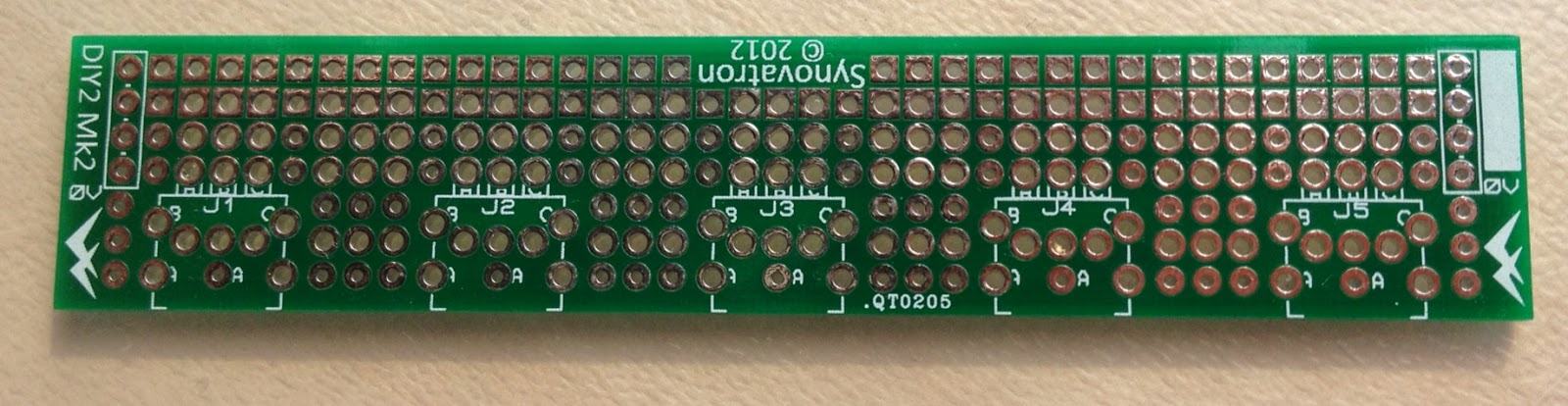
DIY2 jack breadboard PCB


DIY3 jack breadboard PCB

Saturday, 11 January 2014

cvgt MM Buchla Translator ModuleModules

The first cvgt MM modules have started shipping to clients at the top of the pre-order list. If you want to be added to the list then please make contact on synovatron@btinternet.com

I will build in small batches and work through the list in chronological order and will then contact you when your order is ready to ship. Only at that point will I request payment (see prices below). Please note that this does not form any contract between us and you are not in any way commiting yourself to making a purchase until such a time that you make a payment.
 
Initially the cvgt MM will be only available directly from me but if there is enough demand then it is possible they will become available at all the usual distributors in due course. 

The current variants are:-
  • Buchla-Euro (round or hex nuts on 3.5mm jacks; please select)
  • Buchla-Serge*
  • Buchla-BugBrand*
  • Buchla-Fenix*
*These are banana socketed variants and only the colour of the banana sockets is different (to match the target system); All are variants (inc. Euro) are to translate from Buchla to 1V/octave systems.

The User Manual is being worked on and will be ready very soon and will posted here in an update. Please checkout the Eardrill website for more info on the ModuleModule concept and other great products from Chris Muir.


Euro variant
Serge variant
Euro (top), Serge (bottom)


Friday, 6 December 2013

cvgtMM - A ModuleModule version of the CVGT1

This project has kept me busy for the past few months. It was suggested some while ago that I do a ModuleModule version of CVGT1 to go in a Buchla (see my earlier post). My initial thoughts were that it was probably not the best solution as front panel space in a ModuleModule is quite restricted and Buchla real-estate is not cheap. However what I didn't consider was that Buchla can also talk to Serge, BugBrand, Fenix etc and Serge users seemed to want this solution. Consequently I set about designing (or redesigning) CVGT1 to fit in a ModuleModule form factor. Chris Muir from Eardrill produced a great interface document which defines just about all I needed to know for designing a ModuleModule (I'll refer to ModuleModule as MM from now on). 

Because of the smaller front panel space I had to lose some features i.e. scaling and offset on the Buchla to other synth CV channel but as it is in a Buchla and will interface to an external 1V/octave synth I've fixed the scaling at 0.8333 (1/1.2) and zero offset. The PCB design allows either 3.5mm jacks or 4mm bananas to be fitted; so one PCB can be configured to for Euro or Serge etc.


Clearly this design has PCBs parallel to the front panel unlike CVGT1 which has them perpendicular hence the change in jack style.  The PCBs had a completely new layout with all front panel related parts on the first board (Front Panel Interface Board) and most of the circuitry on the second (Main Board). Here are some design images of the variants (there are a few very minor tweeks to the graphic since this was drawn and you'll see a few variations in the prototype pics below).


I built a prototype and that's all working nicely. Aside from the new PCB layouts I had to make some changes to the pulse/trigger/gate circuits to run from ±15V rather than ±12V but there were no major changes. Heres a scope image of the Buchla compatible pulse I achieved:-


Here's the prototype with an ink jet printed plastic overlay on the front panel.


All components are conventional through-hole types - I may go over to surface mount if I get more orders than I can personally cope with but think I will still retain through-hole if anyone fancies a kit. You will also notice that the scaling trimmers are front-panel accessible (with a small screw driver) however these are for very fine trimming ±0.5%.

The first pre-production modules will be available in just over a week when the screen-printed panels are in stock. I have a number of interested 'customers' that I will contact soon and will start a pre-order list; please feel free to contact me to get on the list: It will be a 'no-commitment no money up front' arrangement as before with CVGT1 and I will poll all interested parties in turn when I have a module ready to ship to see if you want one. I have not finalised a price yet but guess it will be in the same ballpark as Eardrill's own range of single panel medium complexity MMs.

It will be interesting to see how this takes off, CVGT1 started slow and now there are 200 out there with bags of interest still.  I will do an update in the next week or so. Thanks for reading.

Tuesday, 1 October 2013

Another custom built Euro to Buchla Translator module

I was recently commissioned by a client to build a custom Euro Buchla interface module, similar to the two I previously built, but with offset switching. The previous two designs both had fixed offset and gain and were intended for use with envelopes, LFOs etc. In other words there was no 1V/octave to 1.2V/octave scaling required just offsetting to ensure the Euro signals stayed in the 0-10V range of the Buchla (you can refer back to my earlier post here).


This module is intended to be used alongside my client's CVGT1 module (which provides the ground reference connection) and adds more CV channels. My client uses Expert Sleepers' SilentWay software for pitch sensitive CV and was not interested in scale conversion as the software does the necessary recalibration however he also wanted the flexibility to be able to interface envelopes, transients and LFOs and so wanted to be able to DC shift signals when he needed to.

The spec was 4 channels of Euro to Buchla (scale of 1, 0V or +5V offset) and 1 channel of Buchla to Euro (scale of 1, 0V or -5V offset); so 10 connectors a 5 switches in 8HP.  

My 8HP prototyping panels proved to be difficult as the existing hole positions meant that the connectors and switches would have been too close to each other plus I only had a few left and found they were scratched; they got binned. I used Schaeffer for a quick-turnaround panel; not cheap but very well made. In a moment of madness I got 5 panels made, including engraving (which the original 2 modules didn't have).