The CV1.2, one of the cvgtElements range of DIY circuits, is available and its data pack is ready to view/download on the support page. CV1.2 is ready built and tested, you have to DIY them into your own modules/panels.
CV1.2 takes a Euro 1V/octave CV and translates it into a Buchla 1.2V/octave CV - ideal if you want to take a Euro pitch CV into the Music Easel's pitch KEYBOARD CONNECTION
The
GTPulse datapack is also available to view/download on the support
page.
The online home for my synth projects, ideas and Synovatron products.
Saturday, 13 June 2015
New Euro to Buchla CV Translator - CV1.2
Labels:
analog,
analogue,
Buchla,
CV1.2,
CVGT1,
cvgtElements,
cvgtMM,
DIY,
eurorack,
Format Jumbler,
GTPulse,
modular,
module,
PCB,
synovatron,
synth,
synthesiser,
synthesizer,
Translator
Friday, 22 May 2015
Synovatron Documents Downloads
EDIT 31May 2015:
For those who have tried to download from links printed on kits, fliers and data sheets etc without success: I apologise but the original file hosting site has shut down without warning in recent weeks. All Synovatron docs have now been rehosted onto Google Docs where they can be viewed or downloaded. The new links are shown on the Support tab above where all downloadable documents will be maintained from now on - if you experience any problems with file downloads please email me at synovatron@btinternet.com. Keep an eye out for new and updated documents. Any additions or significant updates will be announced on the blog as they occur.
The documents added to Google Docs are:-
CV Tools User Manual
CVGT1 User Manual
cvgtMM User Manual
GTPulse Data Pack
ASM2DB Adaptor Fitting Instructions & uZeus Tech Note
DM2ASB Adaptor Fitting Instructions
5ASM2DB Adaptor/Expander Bare Board Data Sheet and Fitting Instructions
For those who have tried to download from links printed on kits, fliers and data sheets etc without success: I apologise but the original file hosting site has shut down without warning in recent weeks. All Synovatron docs have now been rehosted onto Google Docs where they can be viewed or downloaded. The new links are shown on the Support tab above where all downloadable documents will be maintained from now on - if you experience any problems with file downloads please email me at synovatron@btinternet.com. Keep an eye out for new and updated documents. Any additions or significant updates will be announced on the blog as they occur.
The documents added to Google Docs are:-
CV Tools User Manual
CVGT1 User Manual
cvgtMM User Manual
GTPulse Data Pack
ASM2DB Adaptor Fitting Instructions & uZeus Tech Note
DM2ASB Adaptor Fitting Instructions
5ASM2DB Adaptor/Expander Bare Board Data Sheet and Fitting Instructions
Labels:
5ASM2DB,
Adaptor,
Analogue Systems,
ASM2DB,
Buchla,
CV Tools,
CVGT1,
cvgtElements,
cvgtMM,
DM2ASB,
GTPulse,
ModuleModule,
uZeus
Saturday, 17 January 2015
ASM2DB Tech Note for use with uZeus ribbon cable bus
Here is a guide if you are using the uZeus ribbon cable backplane.
(apologies I didn't have a real uZeus backplane to hand but hopefully you get the idea)
Saturday, 8 November 2014
Custom Half-width Buchla Modules
I was asked to design and build a pair of custom half-width Buchla modules for some clients. They each had two half-width slots spare in their custom built cases and wanted to fill the spaces with Euro to Buchla CV and gate translator modules.
The brief was simple (and the same for both clients): 5 channels of 1V/oct to 1.2V/oct CV translation and 5 channels of gate boosting to Buchla levels; the Buchla stepped pulse was not required, just big pulses (10V or more).
This was a great opportunity to use the Synovatron Proto range of prototyping boards which accomodate 5 channels and offer stackability if more circuitry is required than will fit on one board; see below.
As the Proto boards are designed primarily for Euro there was space on the 4U Buchla front panels to add some extras in the form of a passive attenuator. Here are the front panel designs that we agreed on:-
To keep costs down it was decided not to have panel marking as the functions are obvious.
The CV module design used a straightforward precision amplifier with gain of 1.2000 (yes that accurate), 1M Ohm input and 0 Ohm output impedances. The gate module used comparators and output and LED drivers. The outputs each have diodes in series allowing them to be wire-ORed by just connecting outputs together (common to Buchla, wish it was used on Euro).
The CV module electronics fitted nicely on a ProtoJax board with plenty of space as you can see:-
For the gate module I decided to put the input comparators and sockets on the ProtoJax board and output buffers and LEDs on the ProtoXp board and stack them together (it probably could all have been put on one board but it was simpler to make use of the space). The stacked ProtoJax and ProtoXp boards can be seen here:-
The gate board was powered from an MTA connector and the CV board took its power from the gate module (hence the 10-pin ribbon headers for a linking ribbon cable); this was at the client's request as they only had one spare connector (these are very low current modules and daisy chaining them didn't cause any crosstalk issues).
The finished panels looked pretty good; they were made by Schaeffer using Front Panel Designer http://www.schaeffer-ag.de/en/front_panel_designer/the_idea/.
If you are interested in the Proto range of PCBs or in having a custom module built then please contact me at synovatron@btinternet.com
The brief was simple (and the same for both clients): 5 channels of 1V/oct to 1.2V/oct CV translation and 5 channels of gate boosting to Buchla levels; the Buchla stepped pulse was not required, just big pulses (10V or more).
This was a great opportunity to use the Synovatron Proto range of prototyping boards which accomodate 5 channels and offer stackability if more circuitry is required than will fit on one board; see below.
![]() |
| The Proto range of boards |
| CV and Gate modules |
The CV module design used a straightforward precision amplifier with gain of 1.2000 (yes that accurate), 1M Ohm input and 0 Ohm output impedances. The gate module used comparators and output and LED drivers. The outputs each have diodes in series allowing them to be wire-ORed by just connecting outputs together (common to Buchla, wish it was used on Euro).
The CV module electronics fitted nicely on a ProtoJax board with plenty of space as you can see:-
For the gate module I decided to put the input comparators and sockets on the ProtoJax board and output buffers and LEDs on the ProtoXp board and stack them together (it probably could all have been put on one board but it was simpler to make use of the space). The stacked ProtoJax and ProtoXp boards can be seen here:-
The gate board was powered from an MTA connector and the CV board took its power from the gate module (hence the 10-pin ribbon headers for a linking ribbon cable); this was at the client's request as they only had one spare connector (these are very low current modules and daisy chaining them didn't cause any crosstalk issues).
The finished panels looked pretty good; they were made by Schaeffer using Front Panel Designer http://www.schaeffer-ag.de/en/front_panel_designer/the_idea/.
If you are interested in the Proto range of PCBs or in having a custom module built then please contact me at synovatron@btinternet.com
Labels:
Buchla,
CVGT1,
cvgtMM,
DIY,
eurorack,
front panel,
jack socket,
modular,
module,
PCB,
prototype,
Prototyping,
schaeffer,
synth,
synthesiser,
synthesizer,
Translator
Saturday, 27 September 2014
Synth Repairs
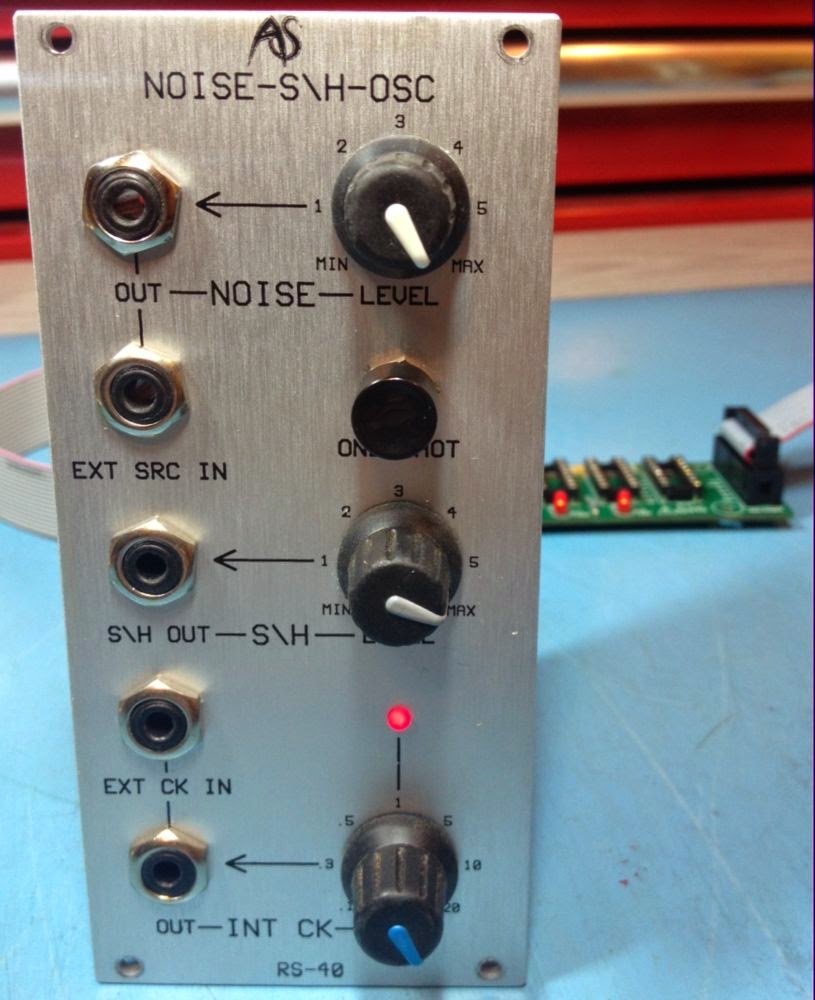
Analogue Systems RS-40 Noise, Sample and Hold, Osc
This came in as 'defective'. After a while it became obvious the noise output was not working. This was traced to an open-circuit LEVEL contol pot (10k lin) which was replaced. Still it didn't work as a sample and hold - i.e. I was expecting to see a stepped output from S\H OUT. Not having used the RS-40 before it took me a while to realise that the noise and clock signals are not normalled to the Sample and Hold circuit like the front panel markings suggest; the lines linking NOISE OUT to EXT SRC IN and INT CK OUT to EXT CK IN suggest to me these are linked in some way but no.
![]() |
| RS-40 |
![]() |
| Noise spikes |
However I didn't much like it and I didn't much like not having the noise and clock not normalled to the S/H circuit. I spoke to the owner and he agreed to have a couple of simple mods applied.
The noise and clock signals are present on the jack board close to where they would have to go for normalled connections. The switched contacts were connected to ground on both EXT SRC IN and EXT CK IN jacks by solder bridges. I removed the solder bridges and fitted links as can be seen here. This worked a treat allowing it to work without patching but still allowing external signals to be patched in if need be.
![]() |
| Solder removed from red arrows and links applied at yellow arrows |
![]() |
| 10nF capacitor |
![]() |
| Spike free steps |
Labels:
Analogue Systems,
modification,
repair,
RS-40,
S/H,
synovatron,
synth
Saturday, 13 September 2014
5 into 1 Analogue Systems to Doepfer Bus Adaptor/Expander
The new 5ASM2DB Analogue Systems Module to Doepfer A-100 Bus Adaptor/Expander is now in stock and available to order.
SchneidersLaden have stock of 5ASM2DB which can be ordered from their website at http://www.schneidersladen.de/en/manufacturer/synovatron.html.
For DIY enthusiasts it is also available as a kit or as a bare PCB direct from Synovatron (please email synovatron@btinternet.com).
The 5ASM2DB offers five Analogue Systems sockets on one small circuit board with low-current LED indicators to show that ±12V and +5V power is available. It comes with a ribbon cable to connect to the A-100 bus and four self-adhesive nylon PCB mounting pillars (you can of course use screwed in pillars so a drilling template will be provided).
If you have several Analogue Systems modules in a Euro rack then the 5ASM2DB could be a better alternative to using several ASM2DB Adaptors because it expands the bus and frees up A-100 Bus connectors for Euro modules; it costs roughly the same as three ASM2DB Adaptors. ASM2DB and DM2ASB Adaptors are still available.
SchneidersLaden have stock of 5ASM2DB which can be ordered from their website at http://www.schneidersladen.de/en/manufacturer/synovatron.html.
For DIY enthusiasts it is also available as a kit or as a bare PCB direct from Synovatron (please email synovatron@btinternet.com).
The 5ASM2DB offers five Analogue Systems sockets on one small circuit board with low-current LED indicators to show that ±12V and +5V power is available. It comes with a ribbon cable to connect to the A-100 bus and four self-adhesive nylon PCB mounting pillars (you can of course use screwed in pillars so a drilling template will be provided).
If you have several Analogue Systems modules in a Euro rack then the 5ASM2DB could be a better alternative to using several ASM2DB Adaptors because it expands the bus and frees up A-100 Bus connectors for Euro modules; it costs roughly the same as three ASM2DB Adaptors. ASM2DB and DM2ASB Adaptors are still available.
![]() |
| 5ASM2DB Adaptor/Expander |
![]() |
| 5ASM2DB Adaptor/Expander |
![]() |
| 5ASM2DB DIY Kit |
Labels:
5ASM2DB,
Adaptor,
Analogue Systems,
ASM2DB,
DIY,
Doepfer,
eurorack,
kit,
modular,
module,
PCB,
ribbon cable,
synovatron,
Thonk
Friday, 29 August 2014
New product preview
This is a design that has been hanging around for over a year in a 95% complete state but I have now taken the bold step of finishing it and going into production. It is called the 5ASM2DB and is a 5 socket version of the popular ASM2DB Analogue Systems module to Doepfer bus Adaptor. It is fabricated on a small circuit board and has 3 LEDs that indicate the presence of ±12V and +5V. The 5ASM2DB will be supplied with 4 self-adhesive nylon mounting pillars and a short ribbon cable so it can be placed adjacent to a busboard and linked via the ribbon cable (standard Euro rack 16 pin cable). It is not recommended for use with the Analogue Systems RS-370 as this draws a whoppng 680mA from the 5V rail.
It will be priced at roughly that of 3 ASM2DB Adaptors so the aim is you get 5 for the price of 3; which will be of interest to those of you with many Analogue Systems modules to go in a Eurorack case.
Availability is from mid-September and will also be available as a DIY kit and as a bare PCB for the more adventurous DIYers. Here's an image from the CAD package - it will not be red BTW!
It will be priced at roughly that of 3 ASM2DB Adaptors so the aim is you get 5 for the price of 3; which will be of interest to those of you with many Analogue Systems modules to go in a Eurorack case.
Availability is from mid-September and will also be available as a DIY kit and as a bare PCB for the more adventurous DIYers. Here's an image from the CAD package - it will not be red BTW!
Labels:
Adaptor,
Analogue Systems,
ASM2DB,
DIY,
Doepfer,
eurorack,
kit,
modular,
module,
PCB,
ribbon cable,
synovatron,
Thonk
Subscribe to:
Posts (Atom)